
In the world of professional services—from management consulting to specialized B2B service providers—a digital presence is not merely a business card, but a strategic infrastructure. While many websites simply list services and rely on generic promises like “We shape your future,” potential clients often fail to find solutions to their specific challenges there. A true platform for management consultancies requires a deep integration of expertise, trust, and technical functionality.
For B2B service providers like management consultancies, a website relaunch means far more than a visual refresh. It is the creation of a system that transforms reputation into measurable results and ensures visibility in modern AI-powered searches.
Why Traditional Websites Are No Longer Enough for Consulting Firms Today
Many consulting firms ask themselves similar questions: How do we showcase our expertise digitally in a way that builds trust? How do we generate qualified leads through the website, and how do we ensure our content appears in AI-powered search results? Often, websites have evolved over time. Services have been added and case studies published, but the structure hasn’t kept pace.
The result is confusing navigation logic, outdated case studies, and virtually no visibility on Google or in AI search. A modern platform treats these elements as a system.
The three core functions of a digital platform
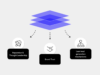
1. Reputation and Thought Leadership
B2B service providers must showcase their expertise. This is achieved not only through service descriptions but also through case studies, white papers, research reports, rankings, and industry articles. This content forms the foundation of their positioning. A platform requires a structured content hub that logically links topics, industries, and methodologies.
2. Brand Trust Through Structure and Visual Confidence
Especially when dealing with public sector clients or large corporations, professionalism is a prerequisite for collaboration. This means: intuitive user guidance, a consistent visual identity, and a precisely structured service architecture. Trust on a digital platform is not built through decorative effects, but through immediate orientation and high-quality, flawless execution across all touchpoints.
3. Streamlined Lead Mechanisms Instead of Aggressive Funnels
Consulting sales processes work differently than in e-commerce. A good platform relies on thematically organized contact options, differentiated inquiry forms, and seamless integration with CRM systems.
Are you looking for a scalable platform for your professional services?
As experts, we help you build a digital infrastructure that builds trust and automates your lead processes for the long term.
AI Visibility in Consulting: What Really Matters
AI is not just a passing trend; it is fundamentally changing how expertise is discovered. The key here is an objective classification of content.
PDFs are taken into account, but rarely used strategically
Modern AI systems can generally read PDFs. The problem lies not in readability, but in structure and contextualization. A PDF is often isolated, not semantically embedded, and has few internal links. It is harder for AI systems to categorize thematically than an HTML structure. What AI prefers is content that is clearly titled and internally linked. Instead of providing a study exclusively as a PDF, it should have its own landing page, contain key findings as structured text, and be linked to relevant services and experts. The PDF remains useful, but now serves only as a supplement.
Clear language instead of jargon
LLMs extract clear statements. Marketing clichés like “We offer innovative solutions for complex challenges” are not helpful. Helpful are concrete phrases such as: “We advise municipalities on data-driven location analyses and competitive comparisons.” Service pages should identify specific problems and precisely describe what is actually being done. AI visibility is created through clarity of language.
Thematic Clusters Instead of Individual Content
A single study is not enough to be perceived as an authority. AI recognizes connections. Anyone who wants to be regarded as an expert on a topic needs a cluster consisting of a central services page, several relevant case studies, supplementary technical articles, and clearly identified points of contact. Isolated content does not establish authority.
Realistically Implementing AI-Powered Lead Qualification
AI doesn’t have to be futuristic in consulting. Practical approaches include structured self-assessments or selecting problem areas in a contact form. Dynamic follow-up questions tailored to the target audience—such as distinguishing between a municipality, an association, or a ministry—enable automatic segmentation in the CRM. This increases the quality of inquiries, not just the quantity.
Case Studies: Expertise in Practice
IW Consult: Structure as a Strategic Lever

The Cologne Institute for Economic Research Consult GmbH primarily advises public sector clients using evidence-based analyses.
- Challenge: Making high-quality thought leadership content accessible in a structured way.
- Solution: A significant visual overhaul and a clean service structure that conveys expertise and professionalism.
- Technology: Implementation on TYPO3 for a highly scalable architecture capable of handling complex data structures.
DHL Consulting: Focus on Recruitment and Employer Branding
For DHL Consulting, the DHL Group’s in-house consulting firm with approximately 150 employees, the relaunch focused on the strategic goal of generating leads in the form of applicants.
- Challenge: Attract top talent while conveying authenticity, approachability, and diversity.
- Solution: A radical focus on visual storytelling. At its core is a modern design language featuring large-scale photo and video productions from a two-day on-site shoot.
- Technology: Built on WordPress to give the team maximum flexibility in content management.
- Result: A highly professional platform that emotionally resonates with skilled professionals and puts the application process front and center.
Do you have similar ideas for your digital platform?
Every consultation has its own unique focus. We translate your vision into a high-performance enterprise solution that reflects your professionalism and strengthens your market position in the long term.
PLAN A PROJECT TOGETHER

CRM and Platform: Why Lead Processes Are an Integral Part
For professional services, CRM is not a separate system but an integral part of the platform architecture. Key questions include: How are website inquiries qualified? What data does the sales team actually need? How do we prevent valuable information from being lost through manual typing or copying between the website and CRM?
This is exactly where we come in. Seamless integration with systems like HubSpot or Salesforce ensures that marketing, business development, and consulting teams all work with the exact same information. As soon as a potential client fills out a form, the data automatically lands in your system without any manual steps in between. This creates a seamless process from the initial website contact to the qualified initial consultation.
When Professional Services Firms Should Strategically Rethink Their Platform
A reorientation makes sense if services have grown significantly, thought leadership isn’t visible enough, or the website generates little organic visibility. Consulting firms should also rethink their platform architecture if leads aren’t sufficiently qualified or if AI-driven visibility hasn’t been considered yet. Especially in the consulting environment, the website is often the first point of contact with potential clients or candidates.
Frequently Asked Questions About Digital Platforms for Counseling
In consulting, differentiation rarely stems from purely technical expertise, but rather from how that expertise is presented. A modern platform uses specific case studies and clear, problem-oriented language to build trust. Instead of generic marketing phrases, we focus on content that makes your unique methods and project successes tangible for both clients and AI systems alike.
The choice depends on your specific needs. WordPress offers maximum agility and flexibility for content-driven marketing strategies. TYPO3 is a robust enterprise solution for complex structures, high security standards, and specific permission systems. Both systems enable professional scaling of your digital platform.
This is often due to the fact that the content is provided solely as a PDF. While search engines and modern AI systems can read these documents, they treat them as isolated content without context. To boost visibility, key findings should be presented directly as structured HTML text on landing pages. This way, your insights will be recognized as authoritative on a given topic and prioritized in search results or AI responses.
As little as possible. Since your focus is on day-to-day operations, we’ll handle the strategic direction and operational implementation. Your input will only be needed on an ad hoc basis during targeted workshops to validate the technical direction and positioning. We manage the design, technology, and all content production independently, so your team remains unburdened.
Absolutely, because successful consulting is based on long-term relationship management. Without integration, valuable information is lost between the initial website contact and the sales process. An integration ensures that inquiries are immediately qualified and assigned to the right expert. This shortens response times and, for the first time, makes the success of your marketing efforts fully measurable.
Conclusion
For professional services, the focus is shifting from mere representation to the scalable delivery of expertise. A modern website for management consultancies strengthens reputation, showcases thought leadership, supports recruitment, and qualifies leads through integrated CRM processes. Those looking to strategically develop their digital presence should focus not only on design, but also on structure, content logic, and system architecture.