The digital world is changing rapidly. Over 90% of all online experiences still begin with a search query, but the way these queries are answered has changed dramatically. Alongside classic search engines like Google, generative engines such as ChatGPT, Bing Copilot, Perplexity.ai and others are emerging — systems that no longer merely retrieve answers from an index, but generate them from vast Large Language Models (LLMs). These systems scan billions of words, sentences and backlinks to compose new texts and present them in search results. For companies, this means: anyone who only optimizes for Google will quickly become invisible in AI-powered answer machines.
In this article, you will learn how Generative Engine Optimization (GEO) works, why it differs from classic search engine optimization (SEO) and Answer Engine Optimization (AEO), and how companies can secure their visibility and discoverability in a world of generative content.
Fundamentals of Generative Engine Optimization
Definition of GEO
Generative Engine Optimization describes all measures aimed at preparing content in such a way that it is recognized, understood and used in responses by generative search systems. While classic search engines display links to web pages, chatbots and AI overviews generate independent texts based on training data. GEO ensures that these models use your brand, your products and your expertise in their responses — whether as a quote, a source or in the context of a recommendation.
The most important insight: generative engines do not only evaluate keywords — they understand context, relevance and authority. They prefer content that is clearly structured, well-substantiated and comes from trustworthy sources.
GEO vs. SEO vs. AEO – What are the differences?
- SEO (Search Engine Optimization) optimizes web pages for rankings on the results pages of classic search engines. On-page factors, backlinks, technical aspects and user behavior all play a role here.
- AEO (Answer Engine Optimization) focuses on appearing in so-called featured snippets or “answer boxes” (e.g. Google’s “People Also Ask”). What counts here are concise answers to specific questions.
- GEO goes one step further: it optimizes content so that LLMs use it when generating texts. It is not enough to simply have an appropriate heading; what matters is structured data, clear semantics, unambiguous entities and source references that build trust. GEO addresses both the preparation of content (formats, structure, metadata) and signals such as brand mentions, links and authority.
Why GEO is relevant for companies
Searchers today expect fast, precise answers — often right within the chat window. Models like ChatGPT deliver summaries and recommendations without users having to click through multiple websites. This opens up many opportunities for companies, but also risks. Those who manage to be mentioned in generative responses build credibility, increase relevance and generate leads even before a click on their own website occurs. Those who are absent from training data or offer unclear content are simply bypassed. Invisibility in generative responses leads to missed inquiries and weakens competitive advantage.
With GEO, you ensure that your company remains present even in the world of AI conversations, and you lay the foundation for upcoming developments such as LLMO (Large Language Model Optimization).
The Influence of AI, LLMs, and Tools such as ChatGPT, Bing und Perplexity

Generative engines are no longer a black box. The most important platforms work differently — and it is precisely these differences that need to be understood in order to be able to optimize in a targeted way.
ChatGPT / OpenAI
OpenAI’s ChatGPT is one of the most well-known systems. It processes requests in a dialogue-based manner and generates responses on the basis of training data collected up to a certain point in time. For companies, this means: content that is regularly updated and linked by trustworthy sources has a higher chance of making it into the model. ChatGPT does not take into account real-time data — and therefore links, sources and structured information are crucial. Find out here how you can use ChatGPT for website optimization.
Google SGE, Gemini & AI Overviews
Google is experimenting with the Search Generative Experience (SGE) and the Gemini model, which combine classic search with generative responses. SGE draws its information from both the index and LLM models — so-called “hybrid” engines. Companies benefit particularly from structure (rich snippets, Schema.org), mentions on topic-relevant pages and strong brand authority. AI Overviews summarize complex topics; anyone appearing in these overviews therefore gains enormous visibility.
Bing Chat / Copilot
Microsoft’s Bing relies on GPT-based models and combines them with current search results. Bing Chat (now often referred to as Copilot) uses Retrieval-Augmented Generation (RAG) to enrich responses with current data. Those who implement JSON-LD and structured data cleanly and regularly update their content are more likely to be taken into consideration.
Other Tools such as Perplexity or You.com
Alongside the major players, there are specialized search and knowledge systems such as Perplexity.ai or You.com. These platforms collect data from various sources and provide responses with source attribution. For companies, this is a great opportunity: when your articles are cited in these systems, it not only increases discoverability but also serves as a signal for other engines.
Generative engines differ in how they function, but they all reward clear structure, authority, backlinks and relevance. Those who understand how the systems work can align their content accordingly in a targeted manner.
Strategies and Measures That Work
GEO is not a trick but a discipline. The following levers determine whether your content is picked up by LLMs:
Structure & Clarity
Generative models favor texts that are easy to analyze. Use clear heading structures, short paragraphs and lists to highlight important information. Subheadings (H2, H3) help identify the context. Long, nested sentences without a clear structure, on the other hand, tend to be overlooked. A good rule of thumb: what is logically structured for human readers also helps machines.
Authority & Citations
LLMs assess whether a source is trustworthy. Articles with source references, citations and links to authoritative sites signal quality. Conversely, backlinks from relevant websites increase the probability that your content will appear in training data. Therefore, maintain a clear link strategy, use external links, but also link internally to thematically relevant pages in order to strengthen the context.
Semantic Connections & Entities
Search engines and Large Language Models (LLMs) understand content not just through keywords, but through entities — clearly defined units such as people, places, products or brands. These entities are interconnected in semantic networks, allowing machines to recognize relationships and better assess how relevant a text is. To become visible here, companies should work with unambiguous terms and define them specifically. Schema.org markups are helpful in supporting this, as they allow entities to be technically labeled. In addition, it makes sense to enrich content with thematically related terms.
Questions, Prompts, and Up-to-dateness: How to Train Your Models Effectively
Many requests to chatbots or generative search systems are formulated as questions, such as “How do I optimize my content?” or “What is GEO?”. That is precisely why FAQ sections and question-and-answer formats are particularly well-suited to being taken into account in generative responses. To ensure that this content remains relevant in the long term, it should be regularly updated. This is because Large Language Models are continuously retrained, and fresh content has a significantly higher chance of being considered in the next training rounds.
Technical measures for an optimized GEO strategy
Alongside content, the technical foundation is crucial. Without clean technical implementation, even the best texts can easily be overlooked.
Structured Data (Schema.org, JSON-LD)
With structured data for articles, FAQs, products or people, you make it easier for search engines and generative models to recognize and correctly classify entities in your content. Particularly useful are FAQ Page markups or HowTo schemas, because they provide AI systems with clear signals as to which content is suitable for responses.
Metadata & Special Tags for AI
In addition to classic meta tags (title, description), some early platforms are experimenting with AI-specific metadata. Some companies integrate “AI hints” into their headers to clarify context for bots. Semantic attributes such as data-ai or data-llm may also become relevant in the future. Importantly: stick to common standards and avoid black-hat tactics — otherwise you risk undermining your credibility.
Indexability & Crawlability
For your content to flow into training data at all, it must be accessible to search bots and LLM crawlers. Faulty robots.txt files, noindex attributes or missing sitemaps can quickly become a problem here. Also pay attention to fast loading times, mobile optimization and clean permalink structures. Technical user-friendliness also influences which pages are prioritized during crawling.
RAG (Retrieval-Augmented Generation) & Co.: How to Integrate Live Data
Systems like Bing combine LLMs with current search data via Retrieval-Augmented Generation (RAG). For companies, this means: recency pays off. Content that is constantly renewed via RSS feeds, APIs or live data has significantly higher chances of being considered by RAG systems in responses. A current blog article is therefore more valuable than an outdated page.
Suitable Content Formats That Land in AI Answers
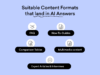
Not every format has the same chance of appearing in generative responses. The following types have proven particularly effective:
Want to appear in the AI responses?
We’ll show you the content formats that deliver results—data-driven and actionable.
FAQ / Q&A Formats
Concise, precise answers to frequently asked questions often land in overviews and chat responses. With FAQ markups, you can give LLMs clear signals as to which content they should use.
How-to Guides and Practical Instructions
Step-by-step instructions provide structure and added value. They are readily used by generative engines to guide users through processes. Pay attention to clear language, numbered steps and supplementary images or videos.
Comparison Tables & Structured Content
Tables, lists and overviews are easy for AI systems to process and are therefore a preferred source for responses. The more structured the data, the more easily it can be transferred into texts.
Expert Articles & Interviews
Quotes from experts and interviews with specialists create authority and credibility. When reputable individuals link to your content, the chances increase that LLMs will classify these statements as trustworthy.
Multimedia Content for Multimodal Optimization
The future of generative systems is multimodal: they process text, images, audio and video simultaneously. Use high-quality graphics, infographics, podcasts or videos and make sure to maintain metadata such as ALT attributes, image captions and transcripts. This ensures that your content remains findable via visual or auditory channels as well.
Measuring GEO Success – What Matters Most
Classic SEO metrics are no longer sufficient to assess the success of a GEO strategy. What matters are new metrics that directly reflect the use of generative systems:
Mentions in Answers and Overviews
Check whether your brand or your content is mentioned in generative responses. Tools like Perplexity.ai indicate which source the information comes from. Manual tests with typical questions can also provide valuable clues.
Traffic Flows from Generative Sources
Analyze the traffic coming from AI-driven platforms. Some analytics tools can display “referrers” such as chat.openai.com or bing.com/new. An increase in these sources indicates that you are appearing in generative responses.
New Forms of Visibility
Beyond clicks, there are now metrics such as impressions in AI Overviews or conversational rank. Such data is partly provided by Google SGE and similar platforms in the Search Console.
Leads and Inquiries from AI Results
The most important KPI remains business success: check whether leads or customer inquiries are increasingly coming from generative channels. A clue might be phrasings such as “I found you on ChatGPT.”
GEO success is measured not only in traffic, but in credibility, authority and conversion rates.
Opportunities and Risks of GEO for Companies

Competitive Advantages Through Early Adoption
Companies that engage with GEO now are securing a genuine first-mover advantage. The more often a brand appears in reputable sources, the more strongly it is “learned” by LLMs and integrated into responses.
Risks of Invisibility in AI-Generated Answers
Those who ignore GEO risk not appearing in generative responses at all. This particularly affects industries where a handful of providers set the tone. Once an LLM preferentially cites a particular company, this pattern solidifies in subsequent training cycles.
Limits of Influence – What Companies Cannot Control
Even with good optimization, some uncertainty remains. AI models can create incorrect contexts, fail to correctly attribute sources or simply hallucinate. Furthermore, access to metrics and training data is limited depending on the platform — companies must learn to work with this uncertainty.
GEO & LLMO – What Comes Next
Generative Engine Optimization is only the beginning. The following developments are emerging in the coming period:
Multimodal Optimization: Interplay of Text, Image, and Audio
Models like Google’s Gemini will in future process information simultaneously via text, images, videos and audio. Companies should already be preparing their content in a multimodal way and providing it with consistent metadata.
Real-time Integration & Live Data via RAG
RAG architectures connect LLMs with current databases. In practice, this means: the more current and well-structured your content is, the more frequently it will be taken into account in generative responses. Live updates, for example via API, ensure that responses are always up to date.
Entity-Centric Optimization as a Standard
The focus is shifting from individual keywords to entities and knowledge graphs. Relationships between people, brands, products and concepts will be the key to visibility.
Hybrid Combinations of GEO & Classic SEO: Why Both Remain and Complement Each Other
SEO remains important — organic rankings continue to drive clicks. GEO complements this approach by increasing presence in answer machines. Successful strategies will combine both disciplines.
Tools & CMS with Native AI Optimization
More and more content management systems (CMS) are integrating AI functions such as automatic schema markups, semantic analyses or direct interfaces to LLMs. Companies should check at an early stage which tools optimize their workflows and which standards are becoming established.
FAQ
GEO refers to the optimization of content so that it is picked up by generative systems such as ChatGPT, Bing Copilot or Google’s AI Overviews and used in responses. It encompasses both the content structure (headings, lists, FAQ formats) and technical aspects such as structured data. The goal is to make one’s own brand visible and relevant when AI systems formulate responses.
SEO optimizes content for organic rankings; GEO, on the other hand, optimizes for generative responses. While SEO relies heavily on keywords and backlinks, GEO emphasizes context, authority and the inclusion of sources. Additionally, inclusion in training data plays a central role.
Generative engines are increasingly becoming the first point of contact for users. Companies that do not appear there lose visibility and leads. GEO creates the basis for products, brands and experts to appear in responses, build trust and thereby pave the way to new customers.
- Structure content (clear headings, FAQs, how-tos) and mark it up with Schema.org.
- Build authority through well-founded articles, source references and high-quality backlinks.
- Use semantics and entities to comprehensively illuminate topics.
- Ensure technical foundations (indexability, fast loading times, structured data).
- Maintain recency and provide regular updates so that content is considered in new training cycles.
Conclusion
Generative Engine Optimization (GEO) expands on traditional SEO by adding a new goal: appearing in AI-generated answers, not just in search results. This requires a clear structure, robust technology, and content that demonstrates authority and context.
Those who act now will secure visibility in generative answers and gain a competitive edge. But please always keep in mind that GEO is not a replacement for SEO, but rather the next stage in its evolution.